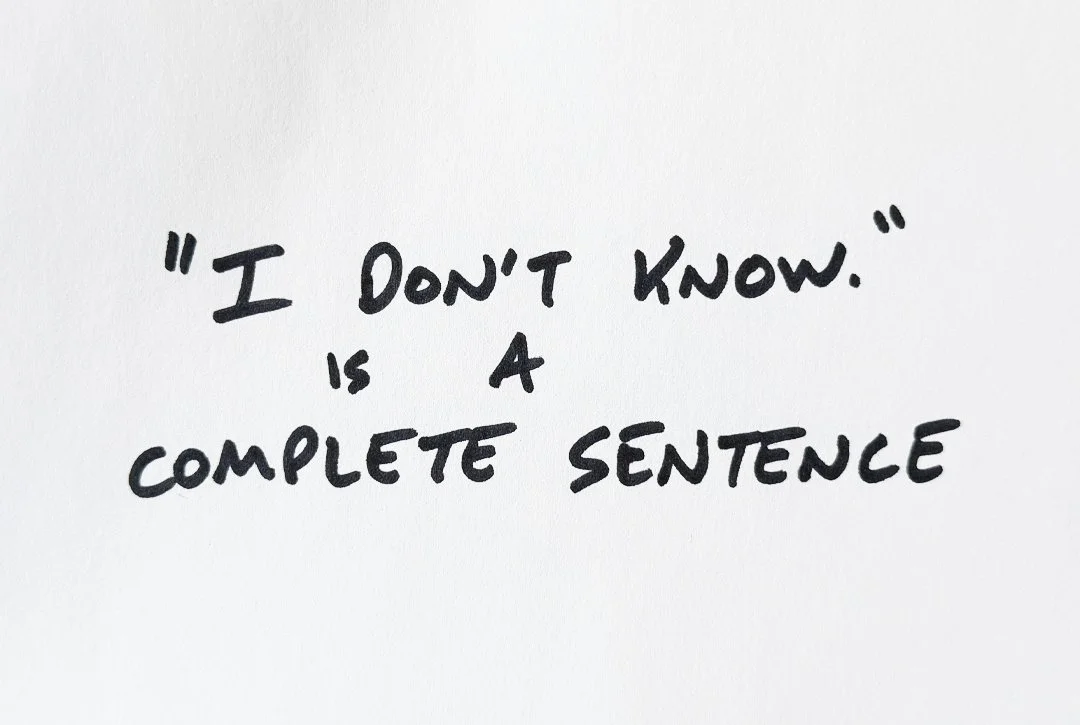
“I Don’t Know.” is a Complete Sentence
Why we should start treating it as such.
I’ve written before about what to say/do when faced with a question you can’t answer. It’s worth a read if you haven’t seen the full thing.
In that post, I outline the options you have when faced with such a question – you can respond in 4 ways (or any combination of the 4):
"Sorry, I don't know."
"I'm happy to jam on it with you."
"Here's a resource that might be helpful."
"Here's someone I think you should connect with about it."
But there’s one piece that was overlooked in my previous post that’s worth going back to: the fact that “I don’t know.” is a complete sentence.
No, really – it has a subject and predicate and everything!
But this isn’t about grammar, it’s about the discomfort of not knowing and the need to fill the silence to avoid looking uninformed or unprepared.
I’ve often observed (observations of myself included) that people don’t treat “I don’t know” as the complete sentence that it is.
“I don’t know” is often followed by the speaker beginning to guess, offer an opinion anyway, explain why there are gaps in their knowledge, or immediately call on someone else to attempt an answer.
But the thing is, complete sentences can be just that – complete. Note the period and the full stop. It’s completely ok if you want to just leave it there – no guessing, opining, explaining, or outsourcing needed.
It’s worth noting that saying “I don’t know” isn’t an excuse to be lazy, to not know the material, or to have not completed the required reading. It’s about leading with honesty before deciding what comes next.
So let’s treat “I don’t know” as a complete sentence as we’re the one answering – and let’s allow the answer when we’re the one asking.
Once we’ve done that, options 2-4 from the list above are still available to you!
Thanks for spending time with me in my workshop,
Eric